
Digitise with SharePoint
Is Low-Code Worth It? Calculate Your ROI in Minutes
Wondering if a low-code platform is worth the investment? Use skybow's free ROI calculator to see when automating your M365 processes pays off.

Sarah Winzer

You have probably seen the demos. Maybe you have already sat in a meeting where someone showed how a manual process could run itself inside SharePoint. And still, one quiet question sits in the back of your mind: is this actually worth it — and when does it pay off?
It is a fair question. Software projects have a habit of costing more than promised and delivering later than planned. You cannot walk into a budget conversation with "it feels like we would save time." You need a number. That is exactly why we built a free low-code ROI calculator: it turns the guesswork about SharePoint automation into a figure you can put on a slide in about two minutes.
This post explains why we built it, who it is for, how it works, and why the investment in a low-code platform tends to pay for itself far faster than most people expect. If you would rather just see your own numbers first: run them here.
The question you can't shake: "will this actually pay off?"
Before you calculate anything, it helps to name what you are actually worried about. Because the doubt is rarely about whether automation works. It is about risk, proof, and getting sign-off.
You have been burned by software projects before
If you have been in IT or operations for more than a few years, you have a scar or two. A tool that promised the world and needed six months of consulting to do half of it. A licence bill that quietly doubled. So a healthy scepticism toward the next "just automate it" pitch is not pessimism — it is experience. The right response is not more enthusiasm. It is a number you can defend.
You can feel the waste, but you can't cost it
You know your team spends real hours on the same repetitive things: copying data between lists, chasing approvals over email, re-typing what is already written on a paper form. You can feel the drag. But "a lot of time" is not a business case. Until that vague sense of waste becomes francs per month, it stays a nice-to-have that never makes it onto the roadmap.
You need a number your CFO will accept
Whoever signs off the budget does not care that a workflow is elegant. They care about payback. The moment you can say "this costs X, saves Y per month, and pays for itself in Z" the conversation changes completely. That is the gap the calculator closes.
So we built something you can use yourself. The ROI calculator takes a handful of numbers you already know — how many people, roughly what they earn, how much time goes into manual work — and returns your monthly and annual saving plus the point where the investment breaks even. No sales call required to get the figure. You enter your reality, you get your number.
The goal is not to flatter you with an impressive result. It is to give you a defensible starting point for a decision — one that holds up when someone pushes back on it.
What you'll need: the five inputs
The calculator is deliberately short. Five inputs, no login, no export gate. Here is what each one means and how to think about it.
- Number of Microsoft 365 license users: This is the group of people who could actually use the solutions and workflows you build. Everyone with a Microsoft 365 licence in the relevant part of your organisation. It sets the scale: the more people touched by a process, the larger the saving from fixing it.
- Estimated hourly wage: Enter a blended average across those users, not a single role. A realistic loaded rate matters here. It is what makes the output credible rather than optimistic. If your users are expensive specialists, the cost of manual work is high, and so is the saving from removing it.
- Hours spent on manual tasks per user, per month: The honest one. How many hours does an average user pour into manual and paper-based work each month. This is the re-typing, the forwarding, the "did anyone approve this?" chasing. Most teams underestimate this until they actually watch a week of it.
- Percentage of tasks that could be automated: Not everything can or should be automated, so this is your conservative estimate of how much of that manual load a solution could realistically take off your plate. Starting low keeps the result believable and it is usually still striking.
Optional: project cost
If you know it, add what the solution will cost to build. That could be a fixed price if skybow builds it for you, a partner's implementation fee, or your own internal cost if you build it in-house. Leave it out for a pure operational-saving view, or add it to see the full payback picture including the one-off investment.
See your own number.
It takes about two minutes and no sign-up. → Open the ROI calculator
A real example: run the numbers
Numbers beat adjectives, so here is a concrete run. Picture a mid-sized organisation:
- 500 Microsoft 365 license users
- CHF 30 estimated blended hourly rate
- 10 hours per user, per month on manual and paper-based tasks
- 20 % of that work realistically automatable
- CHF 40,000 one-time project cost
These are deliberately modest assumptions — a low hourly rate, only ten hours of manual work, and just a fifth of it automated. Even so, that manual work is quietly costing the organisation around CHF 150,000 per month. Automating a fifth of it returns roughly CHF 30,000 a month. After the running cost of the platform, the calculator lands on a net monthly saving of CHF 29,058 — about CHF 348,696 a year — and the one-time CHF 40,000 project pays for itself in about two months.
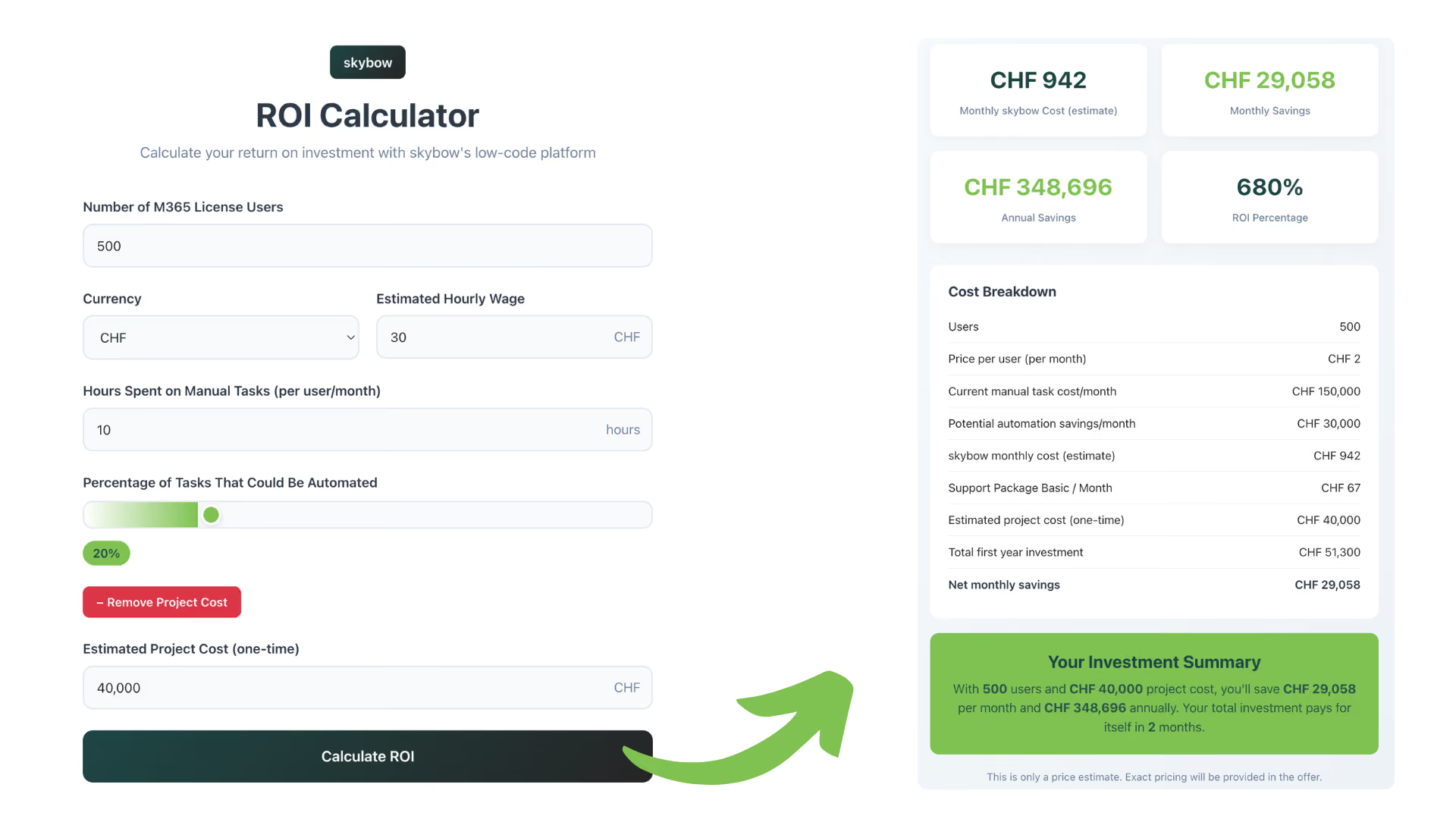
And that is the point of entering your own figures: the case does not rely on optimistic inputs. Raise the hourly rate, add the hours your team really loses, or automate more than a fifth, and the payback only gets shorter — because you are weighing a recurring monthly saving against a one-time build cost. That asymmetry is the whole story.
Why low-code pays off so fast
The example is not a trick of big numbers. It reflects how a low-code investment behaves structurally. Four things drive it.
Recurring saving versus one-time cost
You pay to build a solution once. It then saves time every month, for years. Traditional development inverts this — high upfront cost, slow to change, expensive to maintain. With a low-code approach the build is cheaper and faster, so the line where saving overtakes cost arrives early and never looks back.
And when the process changes, so can the solution: adjustments take minutes, not a change request and a developer queue. That keeps it flexible as your business shifts. And it means no creeping maintenance bill eating into the saving over time.
You are building on infrastructure you already pay for
skybow Studio builds directly on SharePoint and Microsoft 365. So your data stays in the SharePoint lists you already have, and the permissions, governance and security your IT set up years ago apply automatically. There is no new database to migrate data into and nothing extra for IT to secure or maintain.
Your people also keep working where they already are, inside Teams and SharePoint, instead of learning yet another tool. That removes a whole layer of hidden cost and setup that other platforms quietly add back — one of the first things people notice when they compare it to a Power Apps alternative.
The second solution is cheaper than the first
The first workflow you digitise carries the learning curve. Every one after that reuses the same skills, the same platform, the same patterns — so the cost per solution falls while the savings stack. A SharePoint self-service portal for IT requests is not a one-off win; it is the template for the next ten processes you fix.
From number to decision
If you take three things from this:
- The doubt you feel about ROI is reasonable, but it is answerable.
- The saving from manual work is almost always bigger than it feels, because you have never added it up.
- With low-code, a recurring saving against a one-time cost means payback comes fast — usually far faster than a traditional project would allow.
The only number that matters now is yours.
Not the example, not an average — the figure that comes out when you enter your own team, your own rates, your own hours. It is free, it takes two minutes, and there is nothing to sign.
Calculate what SharePoint automation is worth to you.
You want to create your next SharePoint project faster and easier with low-code?
Read more


Let's talk about your workflows
We know the feeling of wanting to get started straight away. Let's create the perfect set-up together.
Ads
Ad-1

Ad-2

Ad-3

Ad-4

Ad-5

Ad-6
